


By Pratim Das, Chief Technology Officer
A token is the unit AI vendors bill by, and many firms now report token use as proof that AI is working. In wealth management, AI output that reaches a client has to be checked before it can be trusted, so consumption says nothing about whether clients are better served.
Measuring technology by how much it gets used is nothing new. Every platform wave has done it: page views, monthly active users, minutes watched. The pitch for AI follows the same pattern. Use more. Prompt more. Build more agents. The bill grows, and so does the dashboard showing "adoption".
Wealth management sees the gap more clearly than most industries. Firms have bought licences, run pilots and launched copilots. Yet very few can point to AI moving the two numbers that matter: the top line and the bottom line.
Why is token consumption the wrong measure of AI value?
Tokens are the meter on the AI taxi: they record how much AI a firm uses. A meter is useful. The trouble starts when the meter becomes the destination.
The evidence that heavy AI use fails to create value keeps growing:
- 95% of enterprise GenAI pilots show no measurable effect on revenue. That's the finding of MIT NANDA's The GenAI Divide: State of AI in Business 2025, which drew on 150 leader interviews, a 350-employee survey and 300 public deployments [1].
- 74% of companies struggle to achieve and scale value from AI. According to BCG, only 4% have advanced AI capabilities across functions [2].
- Over 40% of agentic AI projects will be cancelled by the end of 2027, Gartner predicts. It cites escalating costs, unclear business value and inadequate risk controls. Analyst Anushree Verma describes most of them as "early stage experiments or proof of concepts that are mostly driven by hype." [3]
This is Goodhart's Law in action: when a measure becomes a target, it ceases to be a good measure. If the success metric is tokens consumed, the system will learn to consume tokens.
Why does faster AI drafting slow advice firms down?
Most wealth management firms have pointed AI at efficiency. Draft the suitability report in seconds. Summarise the client meeting instantly. Let an agent chain the workflow together.
It looks fast. Then the hidden work arrives.
In a regulated business, every AI output that touches a client has to be checked, corrected and realigned before it can be trusted. The speed gained at the front is lost at the back, often with interest:
- Workslop is real. In research published in Harvard Business Review, 41% of workers said they'd received AI-generated content that "appears polished but lacks real substance". Each instance took nearly two hours to deal with [4].
- Perceived speed can mislead. In METR's randomised controlled trial, experienced developers using AI tools took 19% longer to finish their tasks. Afterwards, they still believed AI had made them 20% faster [5].
Now put that gap inside an advice process. You add a human checker, then a second line of defence, then a remediation loop. The agent made the task faster, and the business got slower.
Efficiency without accuracy isn't speed. It's rework that has been rescheduled.
As Peter Drucker put it: "There is nothing so useless as doing efficiently that which should not be done at all."
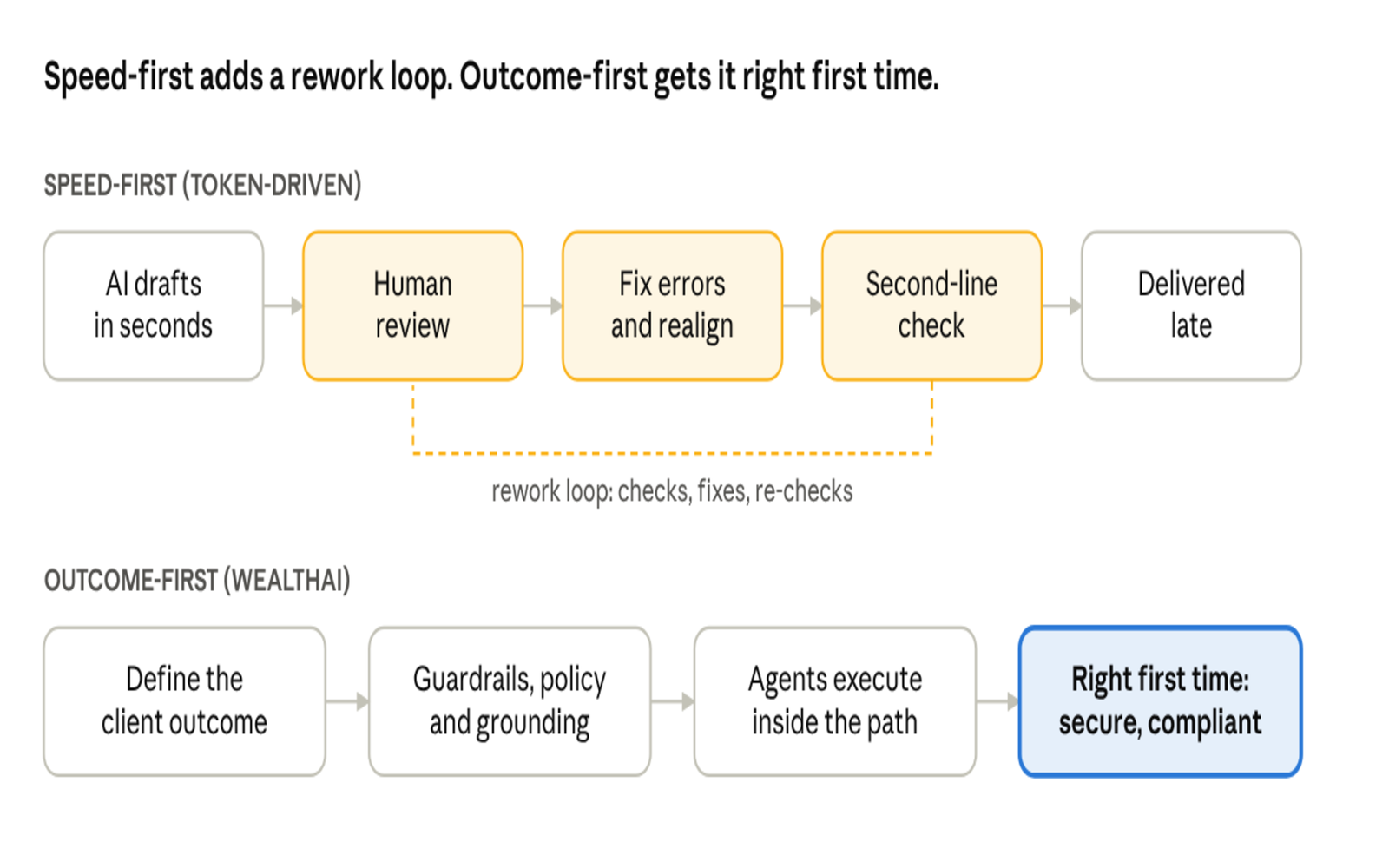
Speed-first AI saves time at the start and then gives it back in review loops. Outcome-first AI designs the checks into the path.
What three outcomes should every AI use case in wealth management prove?
A wealth firm should start every AI project from the client outcome it needs to move, then work backwards. Three questions come first:
- Is the client more secure? Their data, their assets and their identity are protected by design.
- Is the firm more compliant? Outputs are explainable and traceable. They are aligned with suitability and Consumer Duty from the start.
- Is the end investor better served? Advice is better, more personal and faster. Expectations are met, then raised.
Only then should a firm design the agents, the data flows and the human touchpoints. Guardrails, grounding and policy are built into the path, so the output arrives right first time.
The timing matters. McKinsey estimates the US wealth industry faces a shortfall of 90,000 to 110,000 advisers by 2034, which is 30–37% of today's headcount [6]. Closing that gap needs more trusted capacity per adviser.
This is the principle behind WealthAi Assistant, and the results show in live workflows. Saranac Partners moved from manually reviewing 5% of its transaction data every fortnight to automated analysis of every trade within a week of going live.
What does responsible AI mean for a wealth manager?
In financial services, "responsible AI" too often shrinks to a slide on bias and a model card. A wider definition has four dimensions:
- Security. Client data should never become training exhaust. Access should be least-privilege, and every action should be auditable.
- Privacy. Personal data should be minimised, kept within the right boundaries and used only for the purpose it was given for.
- Cost. An unbounded token bill is a governance failure. Right-size models to tasks, and measure cost per outcome.
- Consequence. In wealth management, an AI error can be an unsuitable recommendation, a missed vulnerability flag or a breach of duty.
Regulators are heading the same way. The FCA's Consumer Duty asks firms to put customers' needs first and to evidence good outcomes [7]. The EU AI Act sets strict obligations for high-risk AI systems, such as credit scoring, from 2 December 2027 [8]. They include risk management, activity logging for traceability, human oversight and robustness.
The direction is clear: regulators will audit outcomes.
What should wealth firms measure instead of AI usage?
The best test of any AI initiative is the client outcome it moves. Four questions put that test into practice:
- What if every AI initiative in your firm had to name the client outcome it moves before it was funded?
- What if we reported cost per good outcome as the headline AI metric?
- What if the fastest workflow were the one that never needs a second line of review, because it was right the first time?
- What if AI scaled adviser judgement, so one trusted adviser could serve twice the clients with the same care?
The next chapter of AI in wealth management will be won by whoever proves the most: better outcomes, sound compliance and clients who stay.
Outcomes, not tokens. That's the bet we're making at WealthAi.
See outcome-first AI at work. See how WealthAi builds a workflow back from the client outcome, with the checks designed into the path.
References
- MIT NANDA, The GenAI Divide: State of AI in Business 2025, reported in Fortune, 18 Aug 2025
- BCG, AI Adoption in 2024: 74% of Companies Struggle to Achieve and Scale Value, 24 Oct 2024
- Gartner, Over 40% of Agentic AI Projects Will Be Canceled by End of 2027, 25 Jun 2025
- Niederhoffer et al., AI-Generated "Workslop" Is Destroying Productivity, Harvard Business Review, Sep 2025
- METR, Measuring the Impact of Early-2025 AI on Experienced Open-Source Developer Productivity, 10 Jul 2025
- McKinsey & Company, The Looming Advisor Shortage in US Wealth Management, 10 Feb 2025
- FCA, Consumer Duty
- European Commission, AI Act: Regulatory Framework for AI